

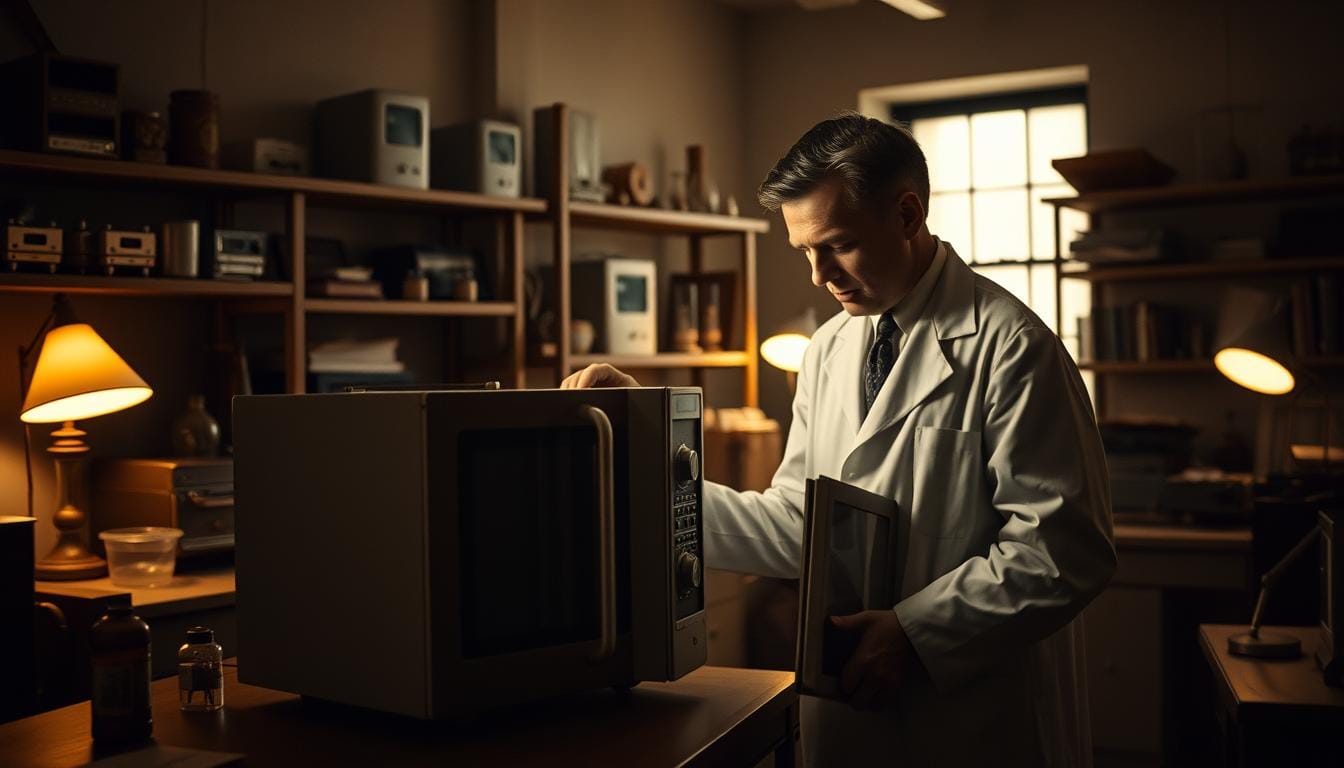
The microwave oven is a common sight in kitchens worldwide. Its history goes back to the mid-20th century. It all started with Percy Spencer, an American engineer at Raytheon. Spencer’s discovery was by accident. He noticed microwaves from a magnetron melted a chocolate bar in his pocket. This led to a series of experiments. These experiments led to the development of the first microwave oven. It was over five feet tall and weighed over 750 pounds.
The first commercial microwave ovens came out in the 1950s. They changed how we cook and heat food. Let’s explore their history, from 1945 to today, and look ahead to 2025.
Key Takeaways
- The microwave oven was invented by Percy Spencer in 1947.
- The first microwave ovens were much larger and heavier than today’s models.
- The invention of the microwave oven revolutionised cooking and food heating.
- Microwave ovens have evolved significantly since their introduction.
- The history of microwave ovens spans several decades, from 1945 to the present.
The Accidental Discovery That Changed Kitchens Forever
Percy Spencer, an engineer at Raytheon, made a groundbreaking discovery by accident. This moment changed kitchen history and how we cook today.

Percy Spencer: From Self-Taught Engineer to Inventor
Percy Spencer started at Raytheon at 18, with no formal education. Despite this, he became a respected engineer, working on magnetrons for radar. His work on magnetrons was key to his microwave cooking discovery.
Spencer’s experience with radar technology was crucial. It helped him develop the microwave oven. His background in magnetrons was essential for the invention.
The Famous Melting Candy Bar Incident of 1945
In 1945, Percy Spencer noticed a candy bar in his pocket had melted near a magnetron. This sparked his curiosity about the effects of microwave radiation on food. It led to experiments that resulted in the microwave oven.
Spencer also tested microwave energy on popcorn kernels and an egg. These experiments showed the power of microwave energy in cooking. They paved the way for the first microwave oven, changing kitchens forever.
When Were Microwaves Invented? The Definitive Timeline
Percy Spencer’s accidental discovery in 1945 started a new cooking era. The development of the microwave oven was rapid, thanks to Raytheon’s innovation.
The path from Spencer’s discovery to the first microwave oven had key moments. Knowing these milestones helps us see how microwaves became common in kitchens.
The First Patent Filing in October 1945
On October 8, 1945, Percy Spencer filed the first microwave oven patent. This was a big step, marking the start of protecting the technology’s rights.
This filing kicked off the official development of microwave ovens.
Early Prototype Development at Raytheon
After the patent, Raytheon started making early microwave oven prototypes. These first models were big and not for home use. Yet, they were important steps towards a working microwave oven.
The team worked hard to make the technology safe and efficient.
The Birth of Commercial Microwave Technology
In 1947, Raytheon launched the first commercial microwave oven, the “Radarange.” It was almost 6 feet tall and cost about $5,000. This made it a big deal for homes and businesses.
The Radarange’s release started the microwave industry. It opened the door for more affordable and practical designs.

| Year | Milestone | Description |
|---|---|---|
| 1945 | Accidental Discovery | Percy Spencer discovers the microwave heating effect. |
| October 1945 | First Patent Filing | Percy Spencer filed the first patent for a microwave oven. |
| 1947 | First Commercial Release | Raytheon releases the first commercial microwave oven, the “Radarange.” |
The First Microwave Oven: The 1947 Radarange
Raytheon’s innovative spirit led to the creation of the Radarange, the first commercially available microwave oven, in 1947. This pioneering device marked the beginning of a new era in cooking technology. It brought the convenience of microwave heating from the research sphere into the commercial realm.

Specifications of the Original Model
The original Radarange microwave oven was huge, standing nearly 5 feet 9 inches tall and weighing over 750 pounds. Its power output was approximately 3,000 watts, much higher than that of many modern ovens. It operated at a frequency of about 2450 MHz, a standard for microwave ovens.
Why It Cost $5,000 and Stood Nearly 6 Feet Tall
The Radarange was priced at a hefty $5,000, about $60,000 today. This made it a big investment for users. The high cost was due to the complex technology, including the magnetron tube that generated the microwaves.
The size and weight were due to the need for shielding to prevent microwave leakage. Also, a bulky power supply was needed to generate the high-power microwaves.
From Military Technology to Commercial Application
World War II radar technology played a key role in the development of the microwave oven. Percy Spencer’s accidental discovery was linked to radar research. This connection was not random; it was a natural step in the technology’s development.
World War II Radar Research Connection
During World War II, the U.S. and other countries focused on radar technology for military gain. Raytheon, a leading electronics company, led this research. The magnetron, a device that makes microwaves, was crucial for radar systems.
This research was the foundation for microwave cooking. The magnetron and radar technology were the starting points.
The link between radar and microwave ovens was based on:
- The magnetron’s ability to create high-frequency microwaves.
- Understanding how microwaves heat materials, seen in radar experiments.
- Raytheon’s existing knowledge and resources in microwave technology.
Raytheon’s Transformation of Wartime Technology
Raytheon recognised the potential of microwave technology beyond the military. They adapted the magnetron and other radar components to make the first microwave ovens. This involved overcoming engineering hurdles, making it safe and affordable for consumers.
Key milestones in Raytheon’s development process included:
- Filing the first patent for a microwave oven in October 1945.
- Developing the first commercial microwave oven, the Radarange, in 1947.
- Enhancing microwave oven design and functionality to reach a broader audience.

The Science Behind Microwave Cooking
Microwave cooking uses electromagnetic radiation. This type of radiation heats and cooks food safely and efficiently. It’s a key part of how microwaves work.
How Microwave Radiation Heats Food
Microwave radiation causes water molecules in food to vibrate. They rotate at the same frequency as the microwaves. This movement creates heat through dielectric heating.
The heat spreads through the food by conduction and convection. Microwaves operate at a frequency of approximately 2.45 gigahertz. This is because water molecules absorb energy most efficiently at this frequency.
The process is efficient and quick. It heats food fast. But heating can be uneven if food is not arranged correctly or if the oven’s power is off.
The Magnetron: The Critical Component
The magnetron is the core of a microwave oven. It creates the microwave radiation that cooks the food. This device turns electrical energy into microwave energy, which goes into the cooking area.
The magnetron’s precise frequency is key to efficient heating. Its development was a significant milestone in the history of microwave cooking. The technology has since evolved, making modern magnetrons more efficient and reliable.
The Journey to American Homes (1960s-1970s)
The 1960s were a big time for microwaves. They moved from commercial kitchens to homes. This decade saw the introduction of smaller, more affordable microwaves to the average American home.
Amana Radarange: The First Countertop Model (1967)
In 1967, Amana launched the Radarange, the first microwave for home use. It was small enough to sit on a kitchen counter. Before, microwaves were huge. The Radarange costs approximately $495, making it more affordable for people to purchase.
Key Features of the Amana Radarange:
- Compact countertop design
- Affordable pricing
- User-friendly interface
When Did Microwaves Become Common Household Appliances?
By the late 1970s, microwaves had become ubiquitous in American homes. Prices dropped, safety improved, and ads helped. The table below illustrates the significant increase in sales.
| Year | Microwave Oven Sales (Units) |
|---|---|
| 1967 | 20,000 |
| 1970 | 400,000 |
| 1975 | 2,000,000 |
The table shows microwave sales grew fast in the late 1960s and 1970s. They went from a rare luxury to a common appliance.
Evolution of Microwave Oven Designs (1970s-2000s)
Since their introduction, microwave ovens have undergone significant changes. They have become a staple in kitchens everywhere. Their design and function have evolved over time.
1970s: Price Drops and Growing Popularity
In the 1970s, microwaves gained popularity as their prices fell. They became smaller and more user-friendly. Companies like Amana and Panasonic made them more affordable for homes.
1980s-1990s: New Features and Compact Designs
The 1980s and 1990s brought new features to microwaves. They could cook in stages and even defrost food. They also became smaller, fitting into tighter kitchen spaces.
During this time, microwaves came in different colors and styles. This made them easier to match with kitchen decor.
2000s: Digital Controls and Integration with Other Appliances
By the 2000s, microwaves were common in kitchens. They started using digital controls, making cooking easier. Some even worked with other appliances, like ovens and hoods.
They also had digital displays and preset cooking programs. This made using them more convenient.
The design of microwaves has changed a lot over the years. This shows how technology and what people want have evolved. Now, microwaves are more efficient and fit well in many kitchens.
Microwave Safety: From Concerns to Regulations
The start of microwave cooking raised both interest and worries about its safety. As these ovens became common in American kitchens, it was crucial to address these concerns.
Early Public Fears and Misconceptions
At first, people thought microwaves could cause cancer or change food’s molecular structure. These worries came from not understanding how microwaves work. As they became more popular, it was clear that education and rules were needed to ensure they were used safely.
Development of FDA Standards and Safety Features
The FDA created safety standards for microwaves to calm public fears. The FDA set limits on radiation leaks from microwaves, making them safe for homes. Companies added safety features like interlock systems and child locks to prevent accidents.
These steps helped reduce microwave accidents and made people trust microwaves as a safe cooking option.
How Microwaves Transformed American Cooking Culture
Microwave ovens changed how Americans cooked and ate. This new technology brought big changes to how we prepare and enjoy meals.
The Rise of TV Dinners and Convenience Foods
The microwave’s popularity grew with TV dinners and convenience foods. These meals were made to heat up fast in the microwave. Swanson’s and Hungry-Man became famous for their microwaveable dishes, meeting the need for quick, easy meals.
| Year | TV Dinner Sales (in millions) | Microwave Oven Sales (in millions) |
|---|---|---|
| 1960 | 10 | 1 |
| 1970 | 20 | 5 |
| 1980 | 50 | 10 |
Impact on Family Meal Preparation and Eating Habits
The microwave changed family meals a lot. Meals were quicker to make, and families used more convenience foods. This change affected how we cook and how we spend time together at meals.
Some say microwaves made cooking skills worse. But others see them as a way to make meal prep easier.
Global Adoption and Cultural Variations
As microwave technology spread around the world, cultures adopted it in their own ways. What was once a luxury item is now a common kitchen appliance in many homes.
The growth of microwave ovens in the international market has shown different patterns in various regions. In countries like Japan and South Korea, microwaves are everywhere. They often come with advanced features, like inverter technology for better cooking.
International Market Growth Patterns
In North America and Europe, microwaves became popular for their convenience. The rise of ready-to-cook meals helped their adoption. These regions focus on energy-saving and smart features.
How Different Cultures Utilise Microwave Technology
Cultures use microwaves differently in cooking. In some Asian cultures, they’re used for steaming food, not just reheating. In Western cultures, they’re mainly for defrosting and cooking frozen meals.
The global use of microwave ovens shows how technology and cooking habits are changing. As technology improves, we’ll see even more creative uses of microwaves in different cultures.
Modern Microwave Innovations and Future Trends
Today’s microwaves are more than just for reheating leftovers. They’ve become smart kitchen tools that you can control easily. You can program them to do more than just heat up food.
Smart Technology Integration and App Control
The newest microwaves have Wi-Fi, so you can control them with your phone. This smart tech lets you start cooking remotely, get cooking alerts, and try different cooking settings. Some even work with voice commands through virtual assistants.
Combination Cooking Technologies and Energy Efficiency
Modern microwaves use new cooking methods for faster, more even results. You can grill, steam, or use convection cooking alone or with microwave power. They also focus on saving energy without losing performance.
| Feature | Traditional Microwave | Modern Smart Microwave |
|---|---|---|
| Control Method | Physical Buttons | Touchscreen, App Control |
| Cooking Technologies | Microwave Only | Microwave, Convection, Grill, Steam |
| Energy Efficiency | Basic Energy Consumption | Advanced Power Saving Features |
Conclusion: From Accidental Discovery to Indispensable Appliance
The microwave oven’s journey from an accidental discovery to a kitchen staple is fascinating. Percy Spencer’s experiment with magnetrons in 1945 started a new era in cooking technology. The first microwave oven, the 1947 Radarange, was huge and expensive but set the stage for today’s models.
Knowing the timeline of microwave oven invention shows the innovation behind it. From the first patent in October 1945 to the first countertop model by Amana in 1967, each step made microwave ovens more common. Now, they are a key part of kitchens everywhere, changing how we cook and prepare meals.
Microwave invention facts and history tell a story of progress and adaptation. Over time, microwave ovens got better, safer, and more efficient. The year 1945 is key in kitchen appliance history, starting a new cooking era. Looking ahead, smart technology and energy savings will likely change microwave ovens even more in our kitchens.
FAQ
Who invented the microwave oven?
Percy Spencer, a self-taught engineer at Raytheon, is credited with inventing the microwave oven.
What was the first microwave oven called?
The first microwave oven was called the Radarange.
When was the first microwave oven invented?
The first microwave oven was invented in 1947.
How did Percy Spencer discover microwave cooking?
Percy Spencer discovered microwave cooking while testing a magnetron. He noticed a candy bar in his pocket had melted.
What was the cost of the first commercial microwave oven?
The first commercial microwave oven, the 1947 Radarange, cost around $5,000.
When did microwaves become common in American homes?
Microwaves became common in American homes during the 1970s. This was after the introduction of the Amana Radarange countertop model in 1967.
How does microwave radiation heat food?
Microwave radiation heats food by causing the water molecules in the food to vibrate. This generates heat.
What is the critical component in a microwave oven?
The magnetron is the critical component in a microwave oven. It is responsible for producing microwaves.
Are microwave ovens safe to use?
Yes, microwave ovens are generally safe to use when operated according to the manufacturer’s instructions and guidelines. The FDA has established safety standards for microwave ovens.
How have microwave ovens impacted American cooking culture?
Microwave ovens have transformed American cooking culture. They popularised convenience foods, TV dinners, and quick meal preparation.
What are some modern innovations in microwave technology?
Modern innovations in microwave technology include the integration of smart technology, app control, combination cooking technologies, and enhanced energy efficiency.